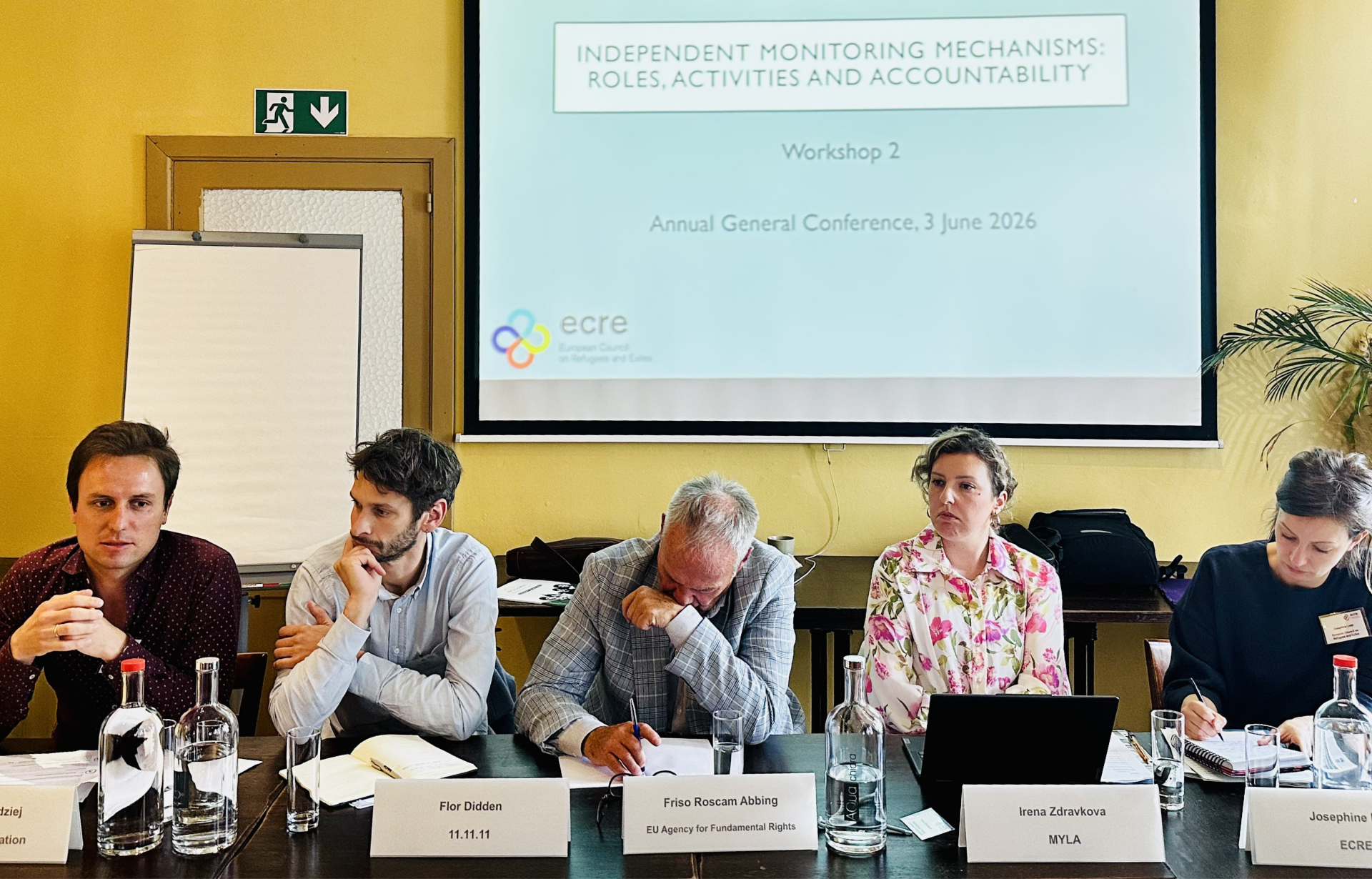
The annual ECRE General Conference, combined with the General Assembly, took place on June 4–5, 2026, in Brussels. ECRE is a European umbrella organization bringing together entities working on behalf of people with refugee backgrounds. The Ocalenie Foundation joined ECRE in 2023 to participate more actively in the exchange of knowledge and experiences among organizations grappling with an increasingly anti-refugee European reality.
At the meeting in Brussels, Ocalenie was represented by Marianna Wartecka and Tadeusz Kołodziej, who also participated in the event as a speaker during the workshop session “Independent monitoring mechanisms for screening and border procedure: Roles, activities and accountability”.
Text of the speech:
The Screening Regulation says that Member States must create an independent mechanism for monitoring fundamental rights. This mechanism should cover, among other things, access to the asylum procedure, the principle of non-refoulement, the best interests of the child, and detention rules. Importantly, the Regulation also points to the need to examine allegations of violations and, where appropriate, to refer cases to civil or criminal procedures. In the Polish context, there are several very concrete areas where such a mechanism could be useful.
First: recording every declaration of intention to apply for international protection.
This is crucial. In practice, the problem often does not start during the formal asylum procedure. It starts earlier, when a foreigner tells a Border Guard officer that they want protection, but later there is no record that such a declaration was ever made. That is why there should be a simple duty to document such situations. It should be recorded when and where the foreigner declared that they wanted to apply for protection, in what language they did so, who was present, whether there was an interpreter, whether the person was sick, injured, with a child, whether they were a victim of violence, and so on. In Poland, the Act on Granting Protection already sets out specific duties for the Border Guard when receiving an application. These include establishing identity, collecting data, taking fingerprints, and providing information in a language that the foreigner understands. The problem is that in many cases the dispute is about whether the foreigner was even allowed to reach this stage.
Second: immediate securing of evidence.
In border cases, evidence has a tendency to disappear. CCTV recordings may be deleted. GPS data from vehicles may not be secured. Medical documentation may never be created. That is why the monitoring body should have the right to request the immediate securing of such materials. I mean especially: camera recordings, GPS data, duty logs, detention documentation, medical documentation, official notes, and information about where the person was transported. Without this, in court we very often face the same situation: the word of the foreigner against state documents, or against the absence of documents.
Third: the possibility of automatically referring the person to legal assistance.
A monitor should not replace a lawyer. But the monitor should be able to trigger contact with a lawyer or a civil society organisation. If the monitor sees that a foreigner may have been pushed back, unlawfully detained, or denied access to the procedure, there should be a clear protocol for action. Such a person should receive information about their rights, contact with legal assistance, and the possibility of a confidential conversation, without officers being present.
Fourth: linking monitoring with complaints to the administrative court.
If the Border Guard does not accept an application for protection or does not perform its duties, under the Polish legal system it is possible to submit a complaint against inaction or excessive delay to the administrative court. The court may order the authority to act and may state that the inaction took place with a gross violation of law. And here the monitoring mechanism can be very important. It can help establish the facts: whether the foreigner declared their intention to apply for protection, whether making such a declaration was effective, whether access to an interpreter was provided, whether the person received instructions, and whether the authority recorded the incident at all.
Fifth: control of detention.
In Poland, a foreigner may be detained, among other reasons, in return-related cases, generally for no longer than 48 hours. After that, the question arises whether the person should be placed in a guarded centre or whether alternatives to detention should be used. The mechanism should check, among other things, whether the person knows why they were detained, whether they received information in a language they understand, whether they had contact with a lawyer, whether the court knew their real situation, and whether health condition, trauma, the presence of children, experience of violence, or particular vulnerability were assessed.
Sixth: a path to the prosecutor and to compensation.
If monitoring reveals violence, unlawful deprivation of liberty, abuse of power, or destruction of evidence, there should be a clear obligation to react. It is not enough to write about this in an annual report. In such cases, a notification to the prosecutor is needed, or the information should be passed to the victim and their lawyer. In detention cases, the Polish Act on Foreigners also allows a person to claim compensation and non-material damages for unlawful detention or unlawful placement in a guarded centre or detention centre for foreigners. That is why the findings of the mechanism should be concrete: date, place, persons involved, description of the incident, documents, and secured materials. Only then can they help in a real case.
Seventh: the role of the Ombudsman and civil society organisations.
In Poland, the natural point of reference is the Ombudsman and the National Mechanism for the Prevention of Torture. But simply naming the Ombudsman is not enough. Such a mechanism needs money, staff, access to the border, the right to make unannounced visits, and the ability to react quickly. Civil society organisations should also be involved, but carefully. NGOs cannot become decoration that gives legitimacy to the system. Taking part in monitoring must not mean that an organisation loses the right to criticise the state, bring cases to court, or support victims independently.
To sum up, a good monitoring mechanism should:
- record declarations of intention to apply for protection;
- secure evidence;
- make contact with a lawyer possible;
- support complaints against inaction;
- control arrest and detention;
- open a path to the prosecutor or to compensation;
- do all of this independently from the services it is supposed to monitor.
If these elements are missing, we will have monitoring without any real effect. If they are included, the mechanism can become something more than reporting. It can become the first step from a violation of rights to state responsibility.
The participation of representatives from the Ocalenie Foundation in this event is co-funded by the National Institute of Freedom – Center for the Development of Civil Society as part of the Government Program for the Development of Civil Society Organizations (#PROO) of the Chancellery of the Prime Minister.